
The landscapes of Funchal, Madeira, served as the backdrop for a full week focused on European digital policy. From April 14 – 16, 2026, the Digital Transformation Summit (DTSummit) brought together the brightest minds from the European Commission, government, academia, and industry.
This year’s edition was particularly impactful, co-located with the I-ESA’26 Conference. This synergy created a bridge between high-level policy objectives – like the EU’s 2030 Digital Compass – and the technical research required for global enterprise interoperability.
The DigiWind project was proud to be at the heart of these discussions, showcasing how specialized education is the engine behind Europe’s clean energy transition.
A Hub of Innovation: Meeting the Consortium
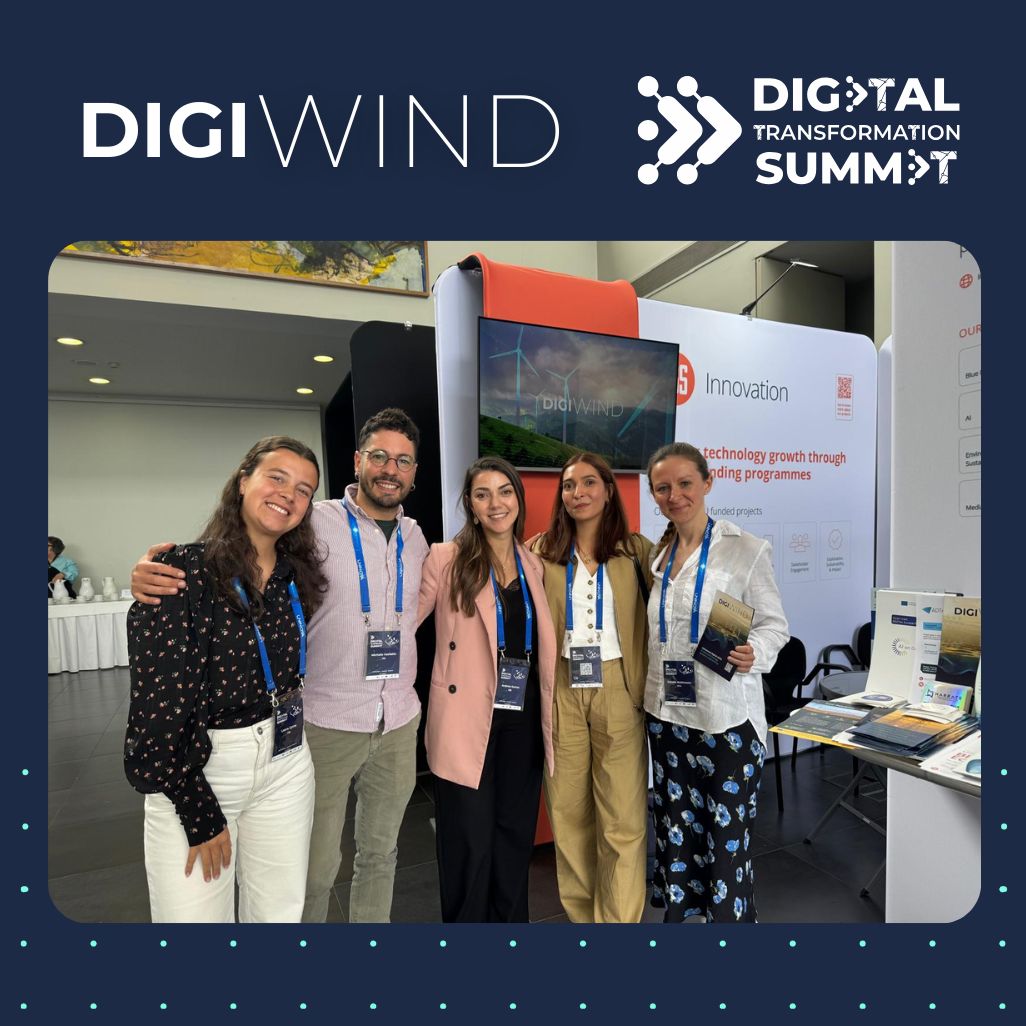
Representing the DigiWind consortium, our partner F6S hosted a dedicated booth throughout the summit. It served as a vibrant meeting point for attendees to engage with the team and explore how we are strengthening the European innovation ecosystem.

Besides DigiWind, visitors had the opportunity to dive into a suite of interconnected projects driving the digital frontier, especially AI-BOOST, an EU-supported open challenge programme that catalyzes breakthroughs in AI through high-stakes competitions and science-based solutions for market challenges, and CIRPASS-2, a project demonstrating the practical implementation of Digital Product Passports (DPP), ensuring circularity and interoperability across textile and electronics value chains.
Spotlight on Skills: “Harnessing Data and AI for People”
One of the week’s highlights occurred on April 14, during the workshop “Skills and Education in the Digital Age: Harnessing Data and AI for People.” As the twin digital and green transitions reshape our global economy, the demand for new competences is skyrocketing. Estelle Stoltmann from DTU Wind and Energy Systems represented DigiWind as a featured speaker, contributing to a vital dialogue on how to prevent skills fragmentation and ensure a human-centered approach to technology.

The workshop brought together five complementary European initiatives (including DS4Skills, DS4Health, and 3D-CIRCULAR) to demonstrate how data infrastructures and AI-enabled learning can empower citizens. The session focused on:
Integrating Sustainability: Linking digital transformation directly with green goals.
Inclusive AI: Emphasizing responsible AI adoption from primary education through to advanced professional training.
Cross-Sector Synergy: Showing how wind energy (DigiWind) and healthcare or agri-food data spaces share a common need for a digitally literate workforce.
Moderated by Tal Soffer and Ricardo Gonçalves, the 90-minute session concluded with a lively Q&A, reinforcing the message that digital transformation must align with societal well-being and inclusive growth.
The conversations held in Madeira underscored a clear reality: Europe’s leadership in wind energy depends as much on data and digital fluency as it does on hardware. By bridging the gap between policy and practical skills, DigiWind continues to ensure that the European workforce is ready for the challenges of tomorrow.
