
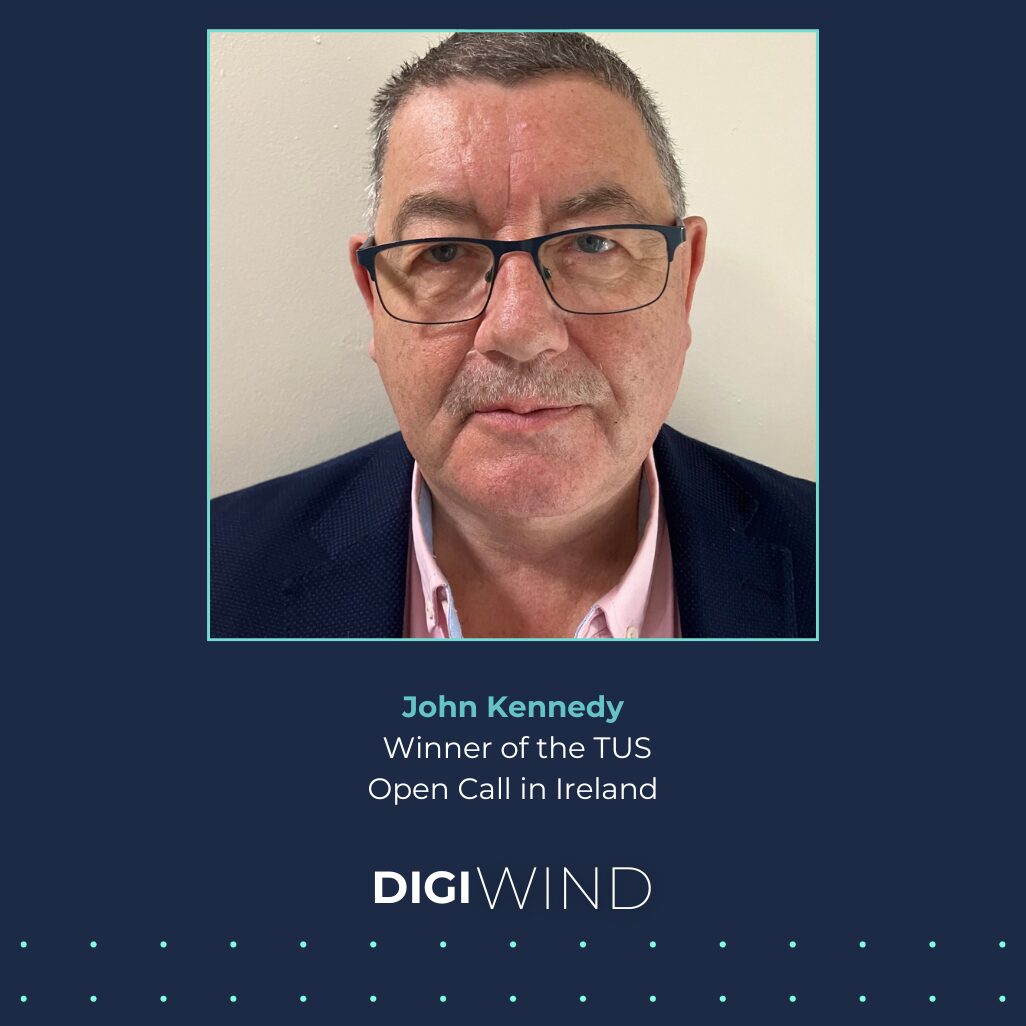
The DigiWind project is proud to celebrate the success of our scholarship winners. As part of our mission to bridge the gap between engineering and digital innovation, we are showcasing the talented individuals who are leading this change!
Our first feature is John Kennedy, winner of the DigiWind TUS first Open Call. With years of experience in the power generation industry, John is now preparing to start his Master’s degree at the Technological University of the Shannon (TUS) in January 2026.
From Industry Experience to Advanced Research
John’s journey is a perfect example of how the DigiWind project supports “Life-Long Learning.” Having already spent years working in power generation, he recently completed his engineering degree with a focus on pumped hydro storage.
Now, through the DigiWind scholarship, he is ready to take his knowledge further. John is particularly interested in grid stability and the digitalisation of energy systems. “I’m looking forward to understanding how renewable and conventional energy can work together in a low-carbon grid,” John says. His goal is to find practical solutions to the challenges Ireland faces in achieving a fully de-carbonised electrical system.
The Impact of the DigiWind Award
For many professionals, returning to education can be a difficult decision due to time and financial commitments. For John, receiving the DigiWind TUS Open Call award has been transformative.
“The award removes barriers that would have otherwise delayed my studies,” John explains. “It allows me to fully commit my time and focus to research and professional development.”
During the application process, John found it valuable to align his previous industry experience with real-world energy needs. This reflection helped him reaffirm his commitment to helping design smarter and more secure power systems for Ireland.
Bridging Research and Innovation
The Master’s programme at TUS is designed to be flexible, combining online learning with classroom sessions and applied research. This structure is what attracted John to the course. He is especially interested in the research element, which will allow him to expand his previous work on hydro storage into new areas like smart grid optimisation.
John believes that the chance to collaborate directly with industry experts is one of the program’s greatest strengths. It reflects the way real-life engineering challenges are solved—through teamwork and practical experience.
A Message for Future Applicants
John’s success shows that it is never too late to advance your skills and shape the future of your career. He encourages others to embrace the challenge of the energy transition.
“This programme is more than just a qualification,” says John. “It’s an opportunity to contribute to a cleaner power future for Ireland and beyond. For future applicants, I would say: your experience and determination can directly shape the future of sustainable energy. It’s never too early, and it’s never too late.”
